
Brief Notes French Think Tank Says Regime Has ‘Infiltrated’ France: French think tank France2050, in its inaugural report, said the Islamic Republic’s embassy in Paris acts as “the European anchor of the Revolutionary Guards’ influence operations,” working to recruit journalists, academics, and...
Brief Notes
French Think Tank Says Regime Has ‘Infiltrated’ France: French think tank France2050, in its inaugural report, said the Islamic Republic’s embassy in Paris acts as “the European anchor of the Revolutionary Guards’ influence operations,” working to recruit journalists, academics, and students across the continent as regime “relays.” The report continues, “In France, the number two of the Iranian embassy, Ali Reza Khalili, was responsible for establishing an influence network: recruiting and directing ‘agents,’ whether they were aware of being manipulated or not.” Presented to the French Parliament and Interior Ministry, the paper concludes that Tehran seeks to sow “chaos without war” in Western democracies. It urges France to map the Islamic Republic’s front organizations, tighten visa controls, and push for the IRGC’s EU terror designation, calling Tehran’s “shadow war” in Europe “active, sophisticated, and persistent.” Supreme Leader’s Advisor Says UK Taking ‘Last Breaths of Power’: Ali Akbar Velayati, a senior international relations advisor to the Supreme Leader, accused the UK of fostering an anti-Tehran atmosphere at the Manama Conference in Bahrain, saying, “The British country that once claimed ‘the sun does not set in his territory’ is apparently in the last breaths of power.” Velayati claimed Britain’s stance against the Islamic Republic at the forum stemmed from its “unprecedented humiliation” by U.S. President Donald Trump at the Gaza summit in Egypt, saying London was now trying “to restore its political prestige.” IRGC Claims to Arrest “Mossad-Linked” Hacker: The IRGC Intelligence Organization (IRGC-IO) announced the arrest of the alleged leader of the Backdoor hacking group, accusing him of collaborating with Israel’s Mossad and opposition networks abroad. The primetime segment of the state broadcaster’s Network Two TV, prepared by journalist Ameneh Sadat Zabihpour (sanctioned for human rights violations), featured blurred videos of the unnamed suspect’s forced confession. Security Chief Walks Back Supreme Leader’s Anti-American Statements: Secretary of the Supreme National Security Council Ali Larijani, in a speech delivered today, said, “The leaders of the Islamic Republic never had inherent animosity or hostility towards the West, but the West's hegemonic behavior and political and security interventions have caused a crisis in cooperation and a decline in the level of relations.” This comes exactly one week after Supreme Leader Ali Khamenei said that tensions between Tehran and Washington are “inherent” and due to a “fundamental incompatibility.” Tehran-Backed Hackers Leak Classified Australian Military Schematics: Tehran-backed hacking group Cyber Toufan has leaked classified plans for Australia’s new Redback infantry fighting vehicles, posting 3D renderings and technical details online. The hackers said the breach stemmed from an earlier breach of Israeli supply-chain firm MAYA Technologies, which has allegedly given it access to data from 17 Israeli defense companies. IRGC Claims Viral Tunnel Construction Videos Have ‘Nothing to Do’ With It: The IRGC Aerospace Force denied that a series of viral videos, originally posted as promotional content by an Iranian company that specializes in the construction of armored doors and safes, show its military facilities. The footage, which online audiences have speculated does indeed show IRGC missile or drone sites, exhibits secure underground tunnels decorated with portraits of Supreme Leader Khamenei. IRGC Aerospace Force spokesperson Ali Naderi said the images have “nothing to do” with the Guards’ facilities, stressing that “authentic images of missile cities are released only through official media channels.” This incident comes amid rising scrutiny of the Islamic Republic’s underground missile network, or “missile cities,” a program Tehran insists is purely defensive and “non-negotiable.”Iran’s Water Crisis Worsens
During a November 6 visit to Iranian Kurdistan Province, President Masoud Pezeshkian said, “If Tehran does not get rain by Azar (starting November 22), we will have to ration water. And if it still does not rain after that, we will have to evacuate the city.” His remarks came as officials announced “extremely fragile” water reserves and state media reported reductions in water pressure across Tehran. Some dailies called the idea of evacuating Tehran a “joke,” while others highlighted other manifestations of the regime’s environmental mismanagement, including severe air pollution.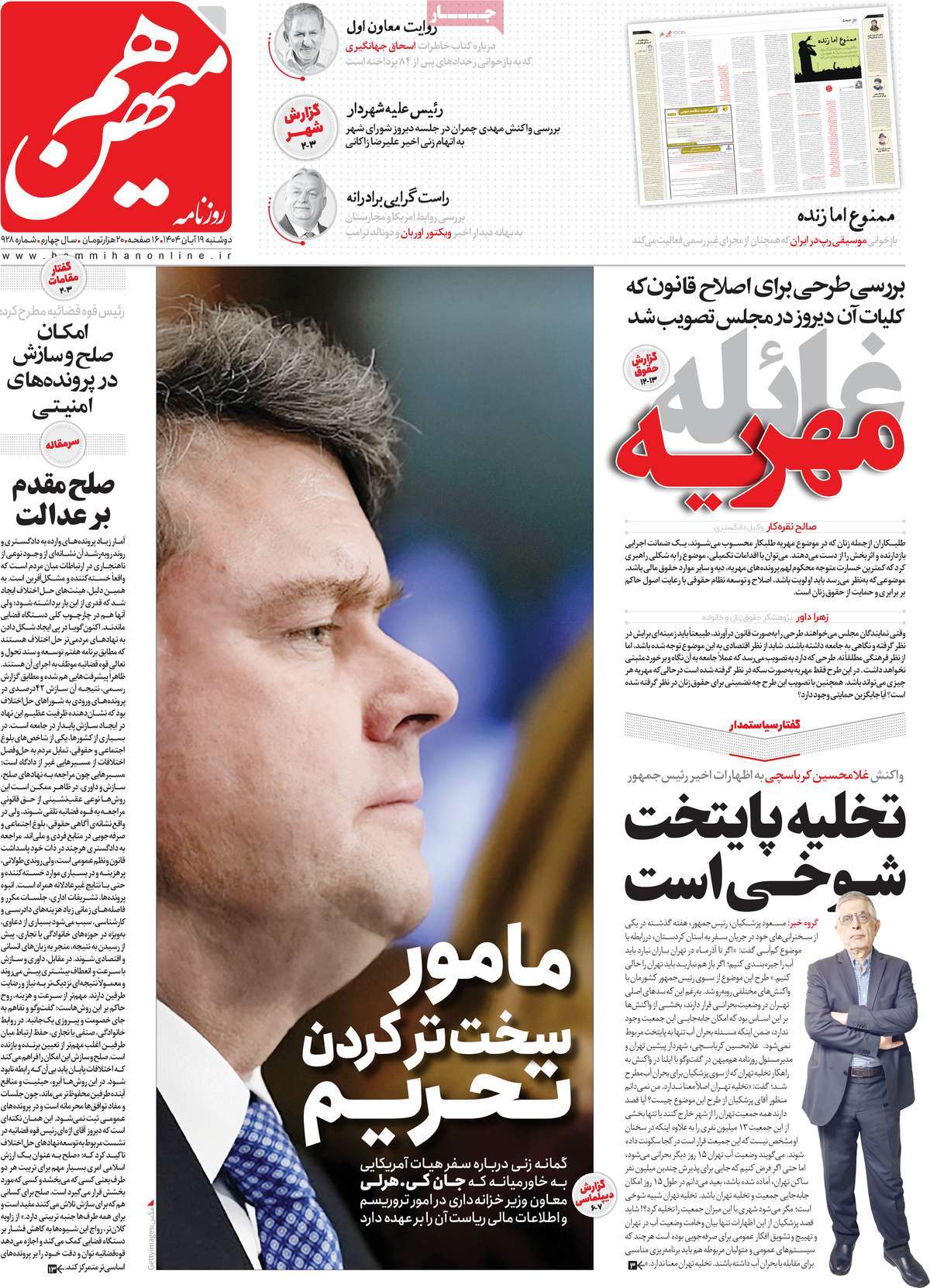
Tehran Condemns U.S. ‘Interference’ in Iraqi Elections
Foreign Ministry spokesperson Esmaeil Baghaei condemned “any foreign interference” in Iraq’s November 11 parliamentary elections, accusing the United States of “harmful” meddling, citing sanctions on pro-Tehran Iraqi militias. Baghaei said “experience shows” that U.S. interference has “damaged peace and stability” in countries like Iraq, while claiming that the “friendly” ties between Tehran and Baghdad would continue “no matter what the election results are.” This comes as Shia militias in Iraq are mounting their biggest political push yet ahead of the November 11 parliamentary elections, seeking to further cement their battlefield clout into Tehran-aligned formal power within Iraqi institutions. In recent months, the militias have expanded their outreach to clerics, tribal leaders, and local influencers. Militia leaders frame support for their candidates as “a new resistance climate” against U.S. and Israel, portraying the election as “a white battle whose weapon is the vote and whose field is the ballot box.” Washington has urged Baghdad to absorb or dismantle the IRGC-aligned militias.On the Radar
- Foreign Ministry spokesperson Esmaeil Baghaei denied last week’s reports that the IRGC plotted to assassinate Israel’s ambassador to Mexico.
- Yesterday, Tehran’s ambassador to Khartoum, Hassan Shah Hussein, met Sudanese Foreign Minister Muhyi al-Din Salim in Port Sudan to call for joint action against the “conspiracies” targeting both countries. The envoy claimed that the Islamic Republic has an “unwavering support for Sudan’s sovereignty and territorial integrity” and condemned “the brutal and terrorist crimes committed by the rebel militia in al-Fashir.”
- Majles (Parliament) Speaker Mohammad Bagher Ghalibaf condemned what he called the “heinous act” of U.S.–Israeli “aggression” against the Islamic Republic, citing President Donald Trump’s recent “candid confession” that he was “very much in charge” of Israel’s June 13 surprise operation that launched the 12-Day War. Speaking in a parliamentary session on November 9, Ghalibaf said Washington must “accept the legal, political, and military consequences” of the attack, which he described as a “grave violation” of international law. He vowed that Tehran would “hold the aggressors accountable.”
- Foreign Minister Abbas Araghchi ruled out any immediate resumption of nuclear talks with the United States, saying dialogue could only continue “on an equal basis,” and that the Islamic Republic has not seen any “positive or constructive” signs from Washington since Oman-mediated talks, which ended in June.
- Gholamreza Jalali, head of the Armed Forces Passive Defense Organization, said that tests following strikes on the Islamic Republic’s nuclear sites showed “no nuclear contamination.” In an interview published November 8 on the YouTube series The Story of War, Jalali explained that the Islamic Republic had “prepared for such a scenario” through drills in Fordow, Natanz, Isfahan, Qom, and Kashan. “These drills were effective: ammonia and chlorine tanks were emptied before the attacks, activities were scaled down, and equipment was relocated,” he said. On Israeli espionage, Jalali said, “Human agents account for about 20–30% of the process…and Iranian experts discovered code that secretly transmitted CCTV camera footage to foreign IPs.” Jalali further acknowledged that “public announcements were halted to avoid causing public stress” during the 12-Day War.
- Israel Hayom reported that Hezbollah’s military capabilities along the border have significantly declined, weakened by ineffective leadership under Naim Qassem, reduced funding from the Islamic Republic, and international sanctions. Still, Hezbollah has managed to rebuild faster than the Lebanese army can confiscate its weapons.
- State TV reported the arrival of the first Russian freight train in Tehran via the Incheh Borun–Turkmenistan border, calling it a major step in expanding Tehran’s regional transit network.
- Former Foreign Minister Mohammad Javad Zarif said he had prepared “an eight-page response to Russian Foreign Minister Sergey Lavrov’s remarks but was instructed by the Supreme National Security Council not to issue it.” Zarif also challenged anyone claiming that the term snapback mechanism appears in the text of the 2015 nuclear deal to “show where it is.” Lavrov had earlier called the snapback clause a “legal trap,” saying it was added during Zarif’s final negotiations with then-U.S. Secretary of State John Kerry, which “surprised” Moscow. Zarif countered that the mechanism actually replaced what he described as a “very bad proposal” from Russia and France.
- The Islamic Republic’s state-run Ofoq TV has started adding Hebrew-language breaking news captions to its talkshow, To Palestine’s Horizon, which covers developments in Israel and the surrounding areas. The show’s host announced the move on November 9, saying the program is being closely watched “in the occupied territories.” The change follows last week’s order for the state broadcaster to launch a full Hebrew-language channel.
- A senior cleric and member of the Assembly of Experts, Mohsen Araki, blamed the country’s deepening drought and declining rainfall on the government’s “lax” enforcement of mandatory hijab rules. Araki claimed that the water shortages and dry conditions were “divine warnings meant to rouse people from their neglect of God.”